108 Prospects to Pro Scouts: What is Perfect Game Baseball and How Does It Work?

What is Perfect Game baseball? Discover the 3 main ways this elite scouting network shapes future MLB draft prospects and youth tournaments.
Every summer, thousands of elite high school ballplayers pack their gear and head to massive stadium complexes in Florida and Georgia. They are chasing a singular dream: catching the eye of a Major League Baseball scout or a Power-5 college coach. In the modern era of amateur sports, the traditional high school season no longer moves the needle on its own. Instead, the entire amateur scouting ecosystem revolves around one massive organization. But what is Perfect Game baseball, and how did a single company become the ultimate gatekeeper to the big leagues?
For parents, players, and casual fans trying to navigate the high-stakes world of travel ball, the organization can look like an overwhelming maze of showcases, national championships, and numeric player rankings. In reality, it operates as a finely tuned talent pipeline. By combining old-school scouting eyes with cutting-edge data tracking, it completely dictates how future stars are found.
Table of Contents
Decoding the Data: The 1-to-10 Grading Scale and Player Metrics

To truly understand what Perfect Game baseball is, you have to look past the double-header schedules and focus on the data. The organization is essentially a high-tech talent laboratory. When an amateur athlete steps onto the field at a showcase, every movement is tracked, measured, and converted into an official “PG Grade.” This single number follows players throughout their high school careers, serving as a universal currency for college recruiters and Major League scouts.
The Famous 1-to-10 Player Grading Scale
The grading system is highly competitive, separating local varsity standouts from elite, Sunday-night-ticket draft prospects:
- Grade 10 (The Elite): Reserved for potential highest-round MLB draft picks or immediate-impact Division-I college stars.
- Grade 9 (The Core D-I Prospect): Signifies a top national talent projectable as a high-round MLB draft consideration.
- Grade 8 (The Safe College Bet): Indicates a high-level prospect projected to succeed at the D-I, D-II, or elite Junior College levels.
- Grade 7 (The Varsity Standout): Marks a solid player who possesses varsity-level skills but requires further physical development.
- Grade 6 & Below (The Developer): Players with basic fundamental skills tracking toward lower-tier college programs.
The Hard Metrics That Matter
A major part of answering what is Perfect Game baseball. It lies in its heavy reliance on advanced analytics. The organization partners with technology leaders like TrackMan and Rapsodo to capture un-fakeable physics data:
- Fastball Velocity: For pitchers, hitting the 90+ MPH threshold on the radar gun is the magic number for serious D-I attention.
- Exit Velocity: This measures the speed of the ball off the bat, proving a hitter’s raw, explosive muscular power.
- 60-Yard Dash: The gold-standard speed test in baseball, where a time under 6.8 seconds flags an athlete as elite.
- Pop Time: For catchers, this tracks the exact seconds from the ball hitting their glove to their throw reaching second base.
By running every athlete through the same testing sequence, the network creates a standardized national leaderboard. This allows a small-town player to stand shoulder-to-shoulder with big-city recruits based purely on verified athletic data.
What is Perfect Game Baseball? How Youth Tournaments and the Wood-Bat Rule Prepare Players for the Pros
When families first ask what is Perfect Game baseball, they often look at the flashing radar guns and the analytical data sheets. However, the true crucible of the organization lies in its strict tournament structures and its famous mandate regarding the equipment used at the plate. Unlike traditional high school or standard travel ball games, where hitters use highly explosive aluminum or composite bats, elite tournaments force teenage prospects to swing wood.
This structural shift completely changes the dynamic of the game, and understanding what Perfect Game baseball is means understanding why the wood-bat rule is the ultimate equalizer for talent evaluators. Aluminum bats feature a massive sweet spot and a trampoline effect that can mask flaws in a batter’s swing mechanics, allowing a sub-par hitter to accidentally drive a ball over an outfielder’s head. A wooden bat offers no such forgiveness, featuring a tiny sweet spot that demands absolute precision, perfect timing, and elite wrist strength to generate any real power.
For Major League Baseball scouts tracking these events, watching teenagers struggle and adapt to wooden bats is the ultimate diagnostic test for professional potential. When people try to define what Perfect Game baseball is, the best answer is that it serves as a direct preview of minor league life. If a sixteen-year-old prospect can step into a batter’s box against a pitcher throwing ninety miles per hour and still barrel up a baseball using a standard maple or ash bat, pro scouts immediately know that player’s offensive skills will translate to the professional level.
This is exactly how youth tournaments across the country weed out the pretenders from the actual draft prospects. The wood-bat rule also serves as a critical test for pitchers, because they no longer have to fear giving up cheap home runs on pitches jammed inside the batter’s hands. Pitchers can attack the strike zone with aggression, knowing that a mis-hit ball off a wooden bat will likely result in a broken piece of lumber rather than a fluke hit, allowing talent evaluators to see how a pitcher commands the zone under true professional conditions.
Furthermore, the sheer environment of these massive tournament complexes reshapes how young athletes handle the mental pressures of professional sports. When explaining what is Perfect Game baseball to outsiders, it is crucial to emphasize that these tournaments are designed to mimic the exhausting, high-stress atmosphere of minor league spring training. Players are forced to play grueling double-headers in sweltering summer heat while dozens of scouts sit behind the backstop with radar guns, stopwatches, and notebooks tracking every single movement.
This intense tournament setting strips away the comfort of playing in front of local hometown crowds, forcing prospects to perform under a microscope against the absolute best pitching and defensive talent in the nation. By combining the physical difficulty of the wooden bat with the mental grind of elite national brackets, the organization transforms youth tournaments into a brutal but necessary finishing school that ensures only the most mentally resilient and physically gifted players advance toward the Major League Baseball draft.
What is Perfect Game Baseball? Understanding the 1-to-10 Player Grading Scale and Live Metrics

To truly understand what is Perfect Game baseball, you have to look past the standard box scores and dive deep into the world of advanced data. The organization essentially operates as a high-tech talent laboratory designed to standardize the evaluation of youth baseball players. When an amateur athlete steps onto the field at a national showcase, every single movement is tracked, measured, and converted into data. A massive part of defining what is Perfect Game baseball lies in its proprietary 1-to-10 player grading system.
This numeric grade serves as a universal currency for college recruiters and Major League Baseball scouts. A grade of 10 signifies an elite, top-tier national prospect who is projected to be a premium MLB draft pick, while a grade of 9 indicates a clear Division I college athlete with professional upside. Lower grades down to a 7 still denote high-quality varsity standouts, but they indicate that the player requires further physical development before they can project cleanly into the professional ranks.
Beyond the scout’s subjective opinion, understanding what is Perfect Game baseball requires analyzing the hard mathematical metrics captured by digital tracking technology during live gameplay. The network partners with industry leaders like TrackMan and Rapsodo to capture completely un-fakeable physics data from every swing, throw, and sprint. For pitchers, the ultimate metric is fastball velocity, where consistently hitting the ninety-mile-per-hour threshold on the radar gun is the benchmark for serious scouting attention.
Position players are judged heavily on exit velocity, which measures the speed of the baseball immediately after it leaves the barrel of the bat, to prove raw muscular power. Furthermore, scouts look closely at the sixty-yard dash to measure pure athletic speed, alongside pop times for catchers to track how many seconds it takes to deliver a throw to second base. By running every teenager through the same rigorous testing sequence, the network answers what is Perfect Game baseball by providing a completely level playing field where a small-town player can stand shoulder-to-shoulder with big-city recruits based purely on verified athletic data.
What is Perfect Game Baseball? Frequently Asked Questions About the Scouting Network
When newcomers dive into the elite youth sports world, figuring out what is perfect game baseball can feel incredibly overwhelming due to the sheer size of the network.
A common question parents often ask when researching what a perfect game of baseball is whether their child must attend a showcase to get ranked by scouts.
The answer is that while playing in national youth tournaments gives athletes great visibility, attending an official showcase is the fastest way to get a verified player grade because that is where the specialized tracking equipment is used to generate profile data. Another major point of confusion when people ask what is perfect game baseball is how the organization differs from standard travel leagues or local little leagues.
To put it simply, the network does not form local community teams, but instead acts as an elite host organization where preexisting independent travel clubs buy into brackets to see how they stack up against nationwide competition.
Families also want to know the financial commitment when investigating what is perfect game baseball and planning their summer budgets. Participating in these events involves considerable entry fees for individual showcases or team tournament passes, meaning that understanding what is perfect game baseball requires recognizing it as a serious financial and athletic investment aimed at securing college scholarships or professional contracts.
Finally, players often wonder if they can still get noticed by Major League scouts if they do not finish with a perfect score on the grading scale. When scouts explain what a perfect game of baseball is to high school players, they emphasize that a lower metric score is not a career death sentence, but rather a developmental baseline showing exactly which physical tools a player needs to improve before the next big national event arrives.
What is Perfect Game Baseball? The Ultimate Conclusion on Youth Scouting Success
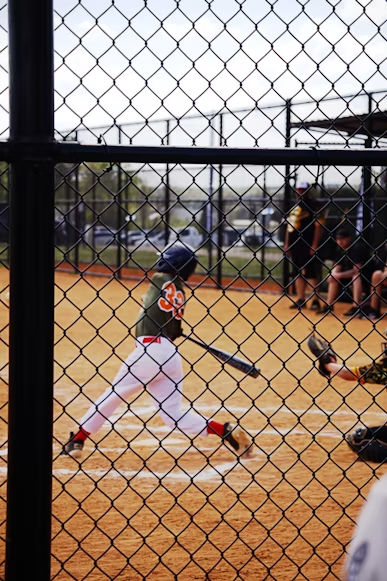
Ultimately, understanding what is perfect game baseball means recognizing it as the most powerful bridge connecting ambitious amateur ballplayers to the highest levels of collegiate and professional sports. The organization has successfully turned the chaotic world of travel ball into a streamlined, multi-million-dollar talent marketplace where data is king and true athletic merit cannot be hidden. When evaluating what a perfect game of baseball is, it becomes clear that its true genius lies in how it serves everyone in the baseball ecosystem simultaneously. It provides parents and players with a realistic, metric-driven roadmap of their actual skills, while offering Major League Baseball scouts a highly efficient, one-stop shop to evaluate the best teenage prospects in the world under professional conditions.
As the landscape of amateur athletics continues to evolve through advanced technology and sports analytics, the influence of this massive scouting network will only continue to grow. For any young athlete who is serious about wearing a professional jersey or earning a college scholarship, learning what perfect game baseball is is no longer just an option, but a mandatory requirement for their career development. By combining the rigid physical testing of the 1-to-10 grading scale, the unforgiving reality of the wooden-bat rule, and the high-pressure environment of national championship tournaments, the network ensures that the path to the big leagues is clearly paved for the next generation of baseball superstars.